
PM2.5 can be filtered. But what about the invisible gases that come with smoke?
When wildfire smoke moves into your community, the first thing you may notice is the haze. The sky changes color. Visibility drops. You may even smell smoke inside your home. But wildfire smoke is more complicated than the particles we can see—or the smoky odor we recognize. Wildfire smoke is a complex mixture of fine particulate matter, gases, vapors, and organic compounds, including volatile organic compounds (VOCs). The U.S. Environmental Protection Agency identifies PM2.5—particles measuring 2.5 micrometers or smaller—as one of the primary health concerns associated with wildfire smoke. Reducing PM2.5 indoors is therefore an important part of protecting indoor air during a smoke event. But it is only part of the picture.
Particles and gases are not the same thing
Wildfire smoke contains two very different types of contaminants. Particles, including PM2.5, are tiny solid particles and liquid droplets suspended in the air. Gases, including many VOCs, exist primarily as individual molecules in the air rather than as particles. That difference matters because the filtration technology that works well for one category may do little for the other. High-efficiency particulate filters—including HEPA filters and appropriately rated HVAC filters—are designed to capture particles as air passes through the filter media. That makes them valuable tools for reducing wildfire-related PM2.5 indoors. But VOCs are not PM2.5. A conventional particulate filter does not remove these gaseous pollutants simply because it is effective at capturing fine particles.
A HEPA filter is designed for particles—not VOC gases
HEPA stands for High-Efficiency Particulate Air. The important word is particulate. EPA guidance explains that air cleaners designed only for particle removal are not designed to control gaseous pollutants. When gas removal is also desired, EPA recommends looking for equipment containing substantial amounts of activated carbon or another media specifically designed for gas-phase pollutants. Even then, gas filtration should not be thought of as universal. Different media remove different gases with different efficiencies, and no typical residential filter can be expected to remove every VOC. So during a wildfire smoke event, your air purifier could be successfully reducing PM2.5 while gaseous components of smoke remain in the indoor environment. That does not mean the particulate filter is failing. It means particles and gases require different approaches.
What VOCs can be found in wildfire smoke?
There is no single universal “wildfire VOC mixture.” The chemicals present depend on what is burning, the temperature of combustion, whether the fire is flaming or smoldering, how long the smoke has traveled, sunlight and atmospheric chemistry, and whether the fire includes buildings, vehicles, plastics, furnishings, or other materials. Researchers have identified hundreds of different VOC species in wildfire smoke. A recent review notes that more than 500 VOC species have been reported and that oxygenated VOCs can make up a substantial portion of the VOC mixture. Several compounds are repeatedly identified in wildfire and wood-smoke research.
Formaldehyde is an oxygenated VOC produced during combustion. A large U.S. study of wildfire-affected communities found median formaldehyde concentrations were approximately 43% higher on smoke-impacted days than on comparable nonsmoke days.
Acetaldehyde is another oxygenated VOC commonly associated with biomass combustion. In the same study, median concentrations were about 36% higher during smoke-impacted periods.
Acrolein is a highly reactive combustion-related compound and respiratory irritant. Researchers found median acrolein concentrations approximately 34% higher on wildfire-smoke days in the multi-year U.S. analysis.
Benzene is produced through incomplete combustion and is frequently reported in wood and wildfire smoke. EPA specifically identifies benzene among toxic pollutants released when wood burns incompletely.
Toluene and xylenes are members of the group often referred to as BTEX compounds—benzene, toluene, ethylbenzene, and xylenes. These compounds have been measured during major wildfire events, including California's Camp Fire. Wildland-urban-interface fires can create particularly complex emissions when homes, vehicles, plastics, and other manufactured materials burn along with vegetation.
Methanol is another commonly reported oxygenated VOC from biomass burning. Recent reviews describe methanol, formaldehyde, and acetaldehyde as examples of the large oxygenated fraction of wildfire VOC emissions.
Other compounds reported in wildfire smoke can include styrene, acetone, furfural, phenol, propionaldehyde, ethylbenzene, xylenes, and other oxygenated and aromatic organic compounds. The important consumer takeaway is not memorizing the chemistry. It is understanding that wildfire smoke contains considerably more than PM2.5.
Wildland-urban-interface fires can be especially complex
A forest fire and a fire moving through a populated neighborhood do not necessarily produce the same mixture of pollutants. When wildfire reaches the wildland-urban interface, smoke may contain emissions from burning building materials, furniture, vehicles, plastics, coatings, treated wood, electronics, and household chemicals in addition to vegetation. EPA research has found that some toxic organic compound emission factors from wildland-urban-interface fires can be substantially greater than emissions from natural fuels alone. That distinction became especially relevant during the January 2025 Los Angeles wildfires.
A 2025 study published in Environmental Science & Technology Letters measured VOCs indoors and outdoors at 22 households near the Palisades and Eaton Fires. Researchers observed wildfire-related changes in VOC concentrations during active burning and after the fires. Outdoor benzene was highest during the initial active-burning period, while some indoor VOC patterns persisted into the post-fire period, particularly in unoccupied homes within burn areas. The findings reinforce an important point: wildfire-related air-quality concerns do not always disappear at exactly the same time as visible outdoor smoke.
Why a lower PM2.5 reading does not necessarily mean every pollutant is gone
Imagine running a high-efficiency air purifier during a wildfire event. Over time, your PM2.5 concentration may fall considerably. That is exactly what you want the particulate filter to accomplish. But a low particle reading tells you specifically about particles. It does not demonstrate that VOC concentrations have fallen by the same amount. The two pollutant classes behave differently, and removing one does not automatically remove the other. That is why it is useful to think of indoor air as a collection of measurements rather than one universal “air quality” number.
Can VOCs be filtered?
Some can be reduced, but the technology is different from particle filtration. Gas-phase filtration commonly uses materials such as activated carbon, which adsorb certain gaseous chemicals onto a large internal surface area. The amount and type of carbon matters. A thin carbon sheet added to a particulate filter may not perform like a purifier containing a substantial bed of activated-carbon media. And different VOCs have different chemical properties, meaning one gas-phase filter may capture one compound more effectively than another.
Therefore:
HEPA or high-efficiency particulate media → primarily targets particles such as PM2.5.
Activated carbon or other gas-phase media → can reduce certain VOCs and gases.
Neither should be described as removing every component of wildfire smoke.
Where lüft® fits
This distinction is particularly important when using an indoor air quality monitor.
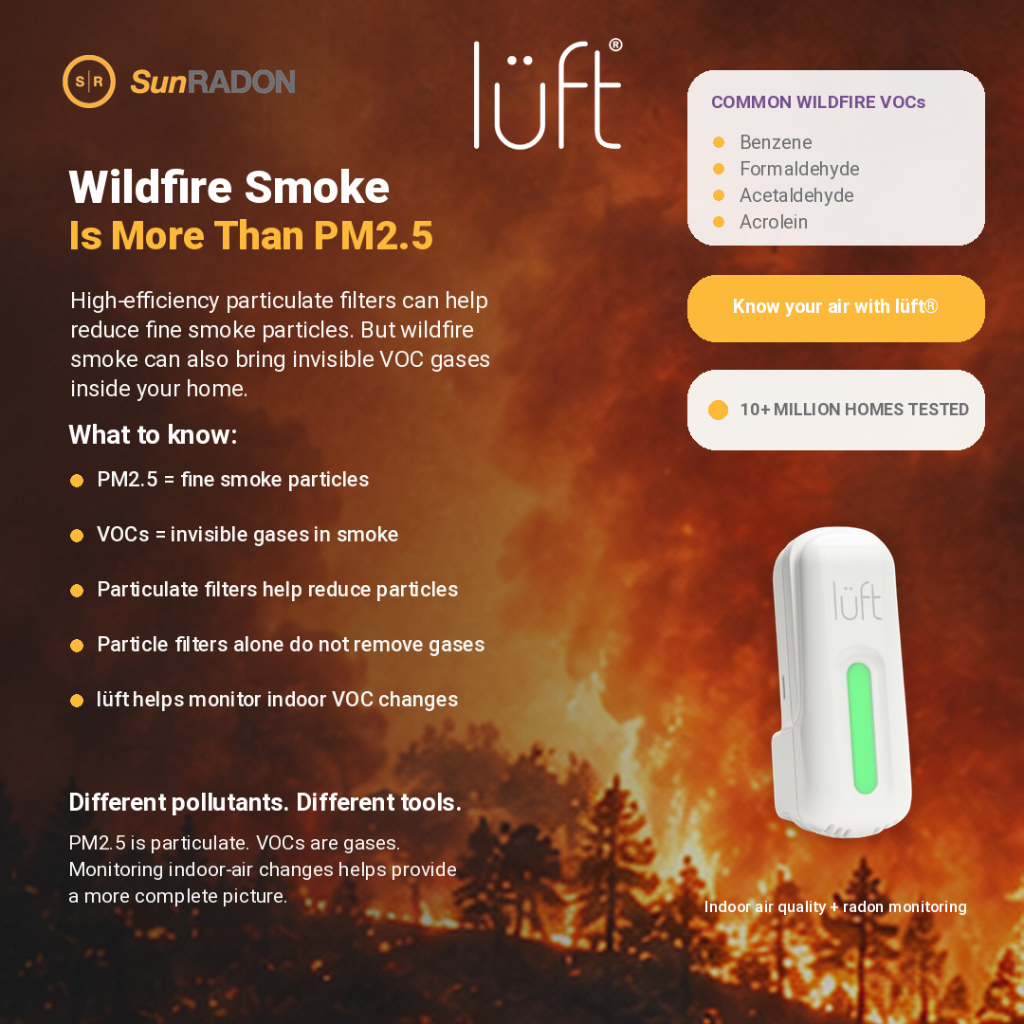
lüft® is designed for continuous indoor air quality and radon monitoring. VOCs is among the pollutants monitored by lüft, together with radon. lüft is not a PM2.5 monitor. Instead, its VOC sensor provides another piece of information about the indoor environment.
lüft's VOC sensor is a relative tVOC sensor. It is designed to recognize changes in mixed VOC levels with high precision rather than identify or report laboratory-grade concentrations of individual compounds such as benzene or formaldehyde. That distinction matters. A lüft monitor cannot tell you: “Your home contains X ppb of benzene from this wildfire.” It can help you recognize that the overall VOC environment has changed.
For a homeowner, that can provide a useful signal to investigate what may be happening indoors and decide whether additional ventilation, filtration, source control, or professional indoor-air-quality assessment is appropriate.
The invisible part of smoke deserves attention too
Wildfire smoke provides a good example of why indoor air quality cannot be reduced to a single number. PM2.5 monitoring tells you about fine particles. VOC monitoring tells you something different about changes in gaseous organic compounds. Radon monitoring addresses a completely different invisible indoor-air risk.
Temperature, humidity, pressure, ventilation, outdoor conditions, and activities inside the home can all influence the overall indoor environment. The goal is not to make homeowners afraid of what they cannot see. The goal is to provide better information so they can make better decisions.
During wildfire smoke, use a layered approach
EPA's newly updated 2026 Wildfire Smoke: A Guide for Public Health Officials continues to emphasize reducing smoke exposure, keeping outdoor smoke from entering buildings when practical, creating cleaner-air spaces, and using appropriate filtration.
For the home, the principle is straightforward: limit smoke infiltration when appropriate, use high-efficiency filtration to reduce particles, consider properly designed gas-phase filtration when gaseous pollutants are a concern, avoid creating additional indoor pollutants, and use indoor-air information to understand how conditions change.
Filter the particles. Monitor what you cannot see.
Wildfire smoke is more than visible haze. It can contain PM2.5, carbon monoxide, VOCs, and many other compounds. High-efficiency particulate filtration is an important and effective tool for reducing indoor smoke particles. But a particulate filter cannot tell you what is happening with gaseous VOCs. That is why monitoring different aspects of indoor air can provide a more complete picture. With more than 40 years in the radon industry and experience testing more than 10 million homes, SunRADON continues to develop tools designed to help people better understand the air around them.
lüft® brings continuous radon and indoor air monitoring into the home—helping to make invisible changes easier to recognize.
Recent references
U.S. Environmental Protection Agency — Wildfire Smoke: A Guide for Public Health Officials, 2026. The newly updated interagency guidance covers wildfire smoke composition, exposure reduction, indoor-air strategies, filtration, and public-health recommendations.
U.S. Environmental Protection Agency — Wildland Fire Research: What’s in Smoke?, updated 2026. EPA research highlights how smoke composition varies by fuel and why wildland-urban-interface fires involving manufactured materials can generate particularly complex hazardous emissions.
Environmental Science & Technology Letters — Indoor and Outdoor Volatile Organic Compound Levels during and after the 2025 Los Angeles Wildfires, 2025. Researchers sampled homes near the Palisades and Eaton Fires and documented changing indoor and outdoor VOC concentrations during active burning and the post-fire period.
Wildfire Smoke and Health Impacts: A Narrative Review, 2024/2025. The review describes the complex gaseous fraction of wildfire smoke, notes that hundreds of VOC species have been identified, and discusses commonly reported compounds including formaldehyde, acetaldehyde, methanol, acrolein, and benzene.
Environmental Science & Technology — Wildfires Increase Concentrations of Hazardous Air Pollutants in Downwind Communities, 2023. Analysis of monitoring data across the western United States found statistically significant smoke-day increases in several pollutants, including formaldehyde, acetaldehyde, and acrolein.

 and then Add to Home Screen.
